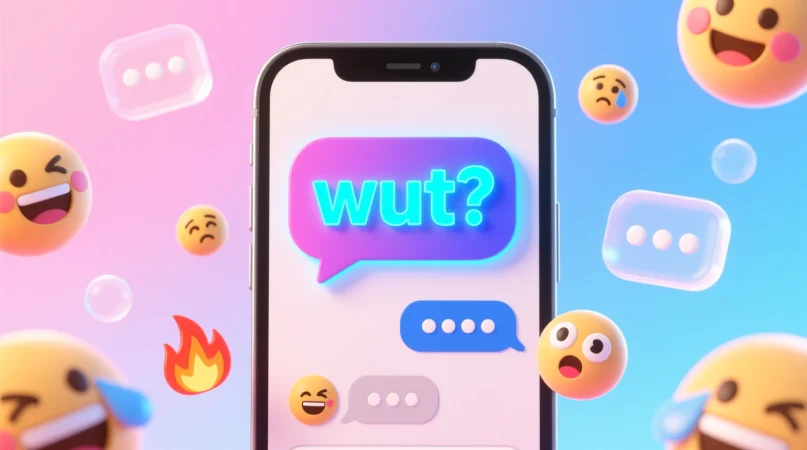
If you’ve ever been texting, scrolling through TikTok comments, or chatting in a fast-paced group chat and suddenly seen someone reply with “wut”, you’re not alone.
Many of my readers especially students, new social-media users, and people trying to stay updated on modern texting slang often get confused by short, weird-looking expressions like this. And that’s exactly why you’re here.
Today, I’ll explain what “wut” means, why people use it, and how you can respond confidently without feeling out of the loop. Let’s break it all down in the simplest way.
Definition & Meaning
“Wut” is an informal, intentionally misspelled version of “what.”
People use it to show surprise, confusion, disbelief, or sometimes playful sarcasm.
It’s not a typo—it’s a tone word. The spelling gives it a more expressive feeling than the plain word “what.”
Examples:
- A: “I just saw someone walking a goat in the mall.”
B: “Wut??” - A: “I’m quitting my job to become a full-time TikTok dancer.”
B: “Wut.”
The emotional tone depends on context:
- “Wut?” = confused
- “Wut.” = shocked, annoyed, or unimpressed
- “Wuuuttt” = exaggerated disbelief
Background & History
“Wut” comes from the early days of internet chatrooms and memes. As people typed faster, slang versions of words became common.
It became popular on:
- 4chan meme culture
- Reddit reaction threads
- Gaming chats
- Tumblr aesthetic text styles
By 2010–2015, “wut” was widely used as a comedic reaction. It often appeared in meme images featuring animals or confused faces.
Today, “wut” is still iconic—a shorthand way to express a reaction that normal spelling just can’t capture.
Usage in Various Contexts
Here’s how “wut” appears in real conversations:
1. Texting
Used when something is confusing or strange.
A: “I’m eating pizza with ketchup.”
B: “Wut?”
2. Social Media
Comments on a shocking video or post.
“Wut did I just watch…”
3. Gaming
Players reacting to unexpected game events.
Player 1: “I got sniped by a level 1.”
Player 2: “Wut lmao”
4. Casual Conversation
Adds humor or disbelief.
Friend: “I woke up at 5pm today.”
You: “Wut.. how??”
Common Misconceptions & Clarifications
Misunderstanding #1:
“Wut” is not always rude.
It can be funny or playful depending on tone.
Misunderstanding #2:
It’s not a spelling mistake—it’s intentional.
Misunderstanding #3:
“Wut” is not offensive.
But it can feel dismissive if used in a serious conversation.
Misunderstanding #4:
It doesn’t always replace “what”—it only fits in surprise or confusion contexts.
Similar Terms & Alternatives
Here are phrases people use instead of “wut”:
| Term | Meaning | Tone |
|---|---|---|
| What | Neutral inquiry | Plain |
| Huh? | Confused | Mild |
| Whaaat?! | Extreme shock | Dramatic |
| WTH? | Disbelief | Slightly strong |
| Bruh? | Confusion + disbelief | Casual & modern |
How to Respond to “Wut”
Your response depends on the situation.
1. Casual Response
“Let me explain 😂”
2. Funny Response
“You heard me right 🤣”
3. Professional-ish Response
“I’ll clarify. Here’s what I meant…”
4. Privacy-Conscious Response
“I’ll share the details later.”
Regional or Cultural Differences
While “wut” is widely understood in English-speaking countries, its usage varies:
- US/UK: Very common in memes and texting
- Asia (especially Philippines, Malaysia, India): Used frequently in casual chats
- Middle East: Common in gaming communities
- Europe: Mostly used by younger internet users
It’s primarily internet slang, not traditional slang.
Comparison With Similar Terms
| Expression | Emotion | Use Case |
|---|---|---|
| Wut | Confusion, shock | Meme-like reaction |
| What?? | Confused | Normal conversation |
| WTF | Strong disbelief | Intense moment |
| Wait what | Surprised + confused | Reactions to unexpected info |
Usage in Online Communities & Dating Apps
On dating apps like Tinder or Bumble, “wut” often shows up when someone says something unexpected.
Example:
A: “I don’t like movies.”
B: “Wut 😳”
On gaming platforms:
“Wut was that glitch?”
On Twitter/X:
Used to respond to strange trending content.
Hidden or Offensive Meanings
“Wut” itself is not offensive.
BUT tone matters.
If you reply “wut.” (with a period), it can feel:
- annoyed
- passive-aggressive
- uninterested
So use it carefully in sensitive conversations.
Suitability for Professional Communication
“Wut” is never appropriate in formal emails or workplace messages.
Instead, use:
- “I’m not sure I understand.”
- “Could you clarify this?”
- “Can you explain further?”
FAQs
1. Is “wut” a rude word?
Not usually, unless used in a dismissive way.
2. Is it a typo or slang?
Slang—people use it intentionally.
3. Can I use “wut” with friends?
Yes, it’s casual and common.
4. Is “wut” used in memes?
Yes, it’s extremely popular in meme culture.
5. Is “wut” the same as “what”?
Not exactly—“wut” carries emotion.
Conclusion
“Wut” is a simple but expressive slang word that shows confusion, shock, or disbelief. It’s a product of meme culture and fast texting, and while it’s fun to use online or with friends, it’s not meant for formal conversations.
Understanding these small slang expressions helps you stay fluent in modern digital language and keeps you from feeling left behind in fast-moving chats.