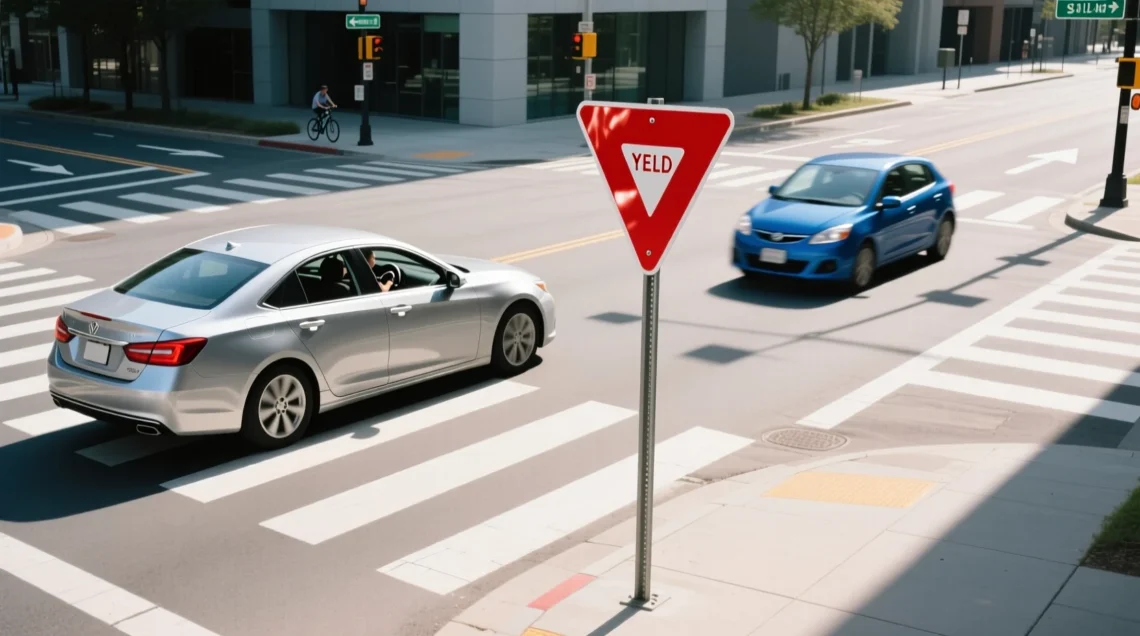
The first time I saw a bright red YIELD sign on the road during my early driving lessons, I slowed down completely because I wasn’t sure what the sign really meant. Was I supposed to stop? Speed up? Wait? My instructor laughed and said, “Relax — yield just means give others the right of way.” After that, everything clicked.
If you’ve ever wondered what yield means in driving, this guide breaks it down in the simplest, safest way possible.
🧠 What Does “Yield” Mean in Driving?
In driving, yield means:
👉 Give the right of way to other vehicles, pedestrians, or cyclists.
You must slow down, check traffic, and only proceed when it’s safe.
✔ Simple Definition:
Yield = Let others go first.
✔ Example Sentence:
“At the roundabout, you must yield to traffic already inside the circle.”
⭐ In short:
Yield = Slow down + Look + Let others pass if needed.
📍 Where Is “Yield” Commonly Used?
You’ll see yield signs and rules in many situations while driving:
🚦 Common Places:
- Roundabouts (you must yield to cars already in the circle)
- Merging lanes
- Highway on-ramps
- Uncontrolled intersections
- Crosswalks
- T-intersections
- Two-lane roads merging into one
- Areas with limited visibility
📝 Tone:
Yielding is a legal requirement, not a suggestion — but it’s also a courtesy-driven concept that ensures smooth, safe traffic flow.
🗣 Examples of “Yield” Used in Driving Conversations
Here are realistic driving-related message examples:
A: should i stop at the yield sign?
B: not always, only if someone’s coming
A: how do roundabouts work?
B: simple, u yield to the cars already going around
A: i almost hit someone on the merge today
B: bro u have to yield before joining the highway 😭
A: is yield same as stop?
B: nope, stop is mandatory, yield depends on traffic
A: failed my test for not yielding to pedestrians
B: yeah they’re always first in crosswalks
A: what do i do at a flashing yellow?
B: yield and move when safe
A: when should i yield exactly?
B: anytime someone else has right of way
🕓 When to Yield and When NOT to Yield
✅ When to Yield
- At yield signs
- When merging onto a highway
- At roundabouts
- When pedestrians are crossing
- When there’s oncoming traffic at an unprotected left turn
- When emergency vehicles approach
- When another vehicle clearly has the right of way
❌ When NOT to Yield
- At a stop sign (you must stop fully)
- When you have a green arrow
- When you already have right of way
- When your yielding could cause confusion or accident
- At traffic lights unless otherwise indicated
📊 Comparison Table: Yield vs Stop vs Merge
| Situation | Required Action | Why |
|---|---|---|
| Yield Sign | Slow down, let others go first | Traffic priority |
| Stop Sign | Full stop, check surroundings | Mandatory safety rule |
| Merge Lane | Yield before joining | Avoid collisions |
| Roundabout | Yield to vehicles inside | Circular flow control |
| Pedestrian Crosswalk | Always yield | Legal & safety priority |
🔄 Similar Terms or Alternatives (Driving Vocabulary)
| Term | Meaning | When to Use |
|---|---|---|
| Right of Way | Priority to move first | Deciding who goes first |
| Merge | Join traffic | Highway on-ramps |
| Give Way | Another term for “yield” | Used in many countries |
| Stop | Full halt | Mandatory intersections |
| Caution | Proceed carefully | Hazard areas |
| Proceed When Clear | Move only when safe | Intersections & merges |
🚘 Why Yielding Matters
Yielding helps prevent:
- Collisions
- Traffic congestion
- Highway pile-ups
- Intersection confusion
- Pedestrian accidents
It’s not just a rule — it’s part of responsible driving.
Yielding shows:
✔ Patience
✔ Awareness
✔ Respect for safety
✔ Understanding of right-of-way laws
⚠️ Common Mistakes Drivers Make with Yielding
❌ Treating yield like a stop sign
Many new drivers brake too hard or stop unnecessarily.
❌ Forcing their way into traffic
Dangerous in merges and roundabouts.
❌ Yielding when they shouldn’t
This causes confusion and potential rear-end collisions.
❌ Ignoring pedestrians
One of the most common driving test failures.
❌ Not checking blind spots
Always double-check before entering traffic.
🚦 Everyday Examples of Yielding
Here’s how yield works in common situations:
⭐ Example 1: Roundabout
You slow down → look left → if cars are coming, wait → enter safely.
⭐ Example 2: Merging Highway
Adjust speed → check mirrors → yield → merge smoothly.
⭐ Example 3: Uncontrolled Intersection
If another car gets there first → you yield.
⭐ Example 4: Pedestrian Crosswalk
Even without a sign → pedestrians always have priority.
⭐ Example 5: Emergency Vehicles
No matter your lane → you yield immediately.
🙋 FAQs
1. Does yield mean stop?
No — only stop if traffic is coming.
2. What happens if I don’t yield?
You may cause an accident or receive a traffic ticket.
3. Do pedestrians always have right of way?
Yes, especially in crosswalks.
4. What’s the difference between yield and give way?
They mean the same thing — “give way” is used in the UK and many countries.
5. Should I yield when merging?
Yes, merging drivers must yield to traffic already on the road.
6. Is a yield sign a warning or a rule?
A legal rule — ignoring it is a traffic violation.
7. Why is the yield sign triangular?
Triangles are internationally recognized as “caution” shapes.
📝 Mini Quiz — Test Your Understanding!
1. What does “yield” mean?
a) Stop completely
b) Give others right of way ✔
c) Speed up
2. Do you always need to stop at a yield sign?
a) Yes
b) No ✔
c) Only at night
3. Who has priority in a roundabout?
a) You
b) Cars entering
c) Cars already inside ✔
4. Merging drivers must:
a) Force their way in
b) Yield to highway traffic ✔
c) Stop before entering
5. Yielding prevents:
a) Smooth traffic
b) Accidents ✔
c) Pedestrians crossing
📝 Conclusion
Yielding is one of the most important concepts in driving. It means allowing others to go first, ensuring safe, smooth, and predictable traffic flow. Whether you’re merging, approaching a roundabout, or letting pedestrians cross, the rule is simple:
👉 Slow down, look, and proceed only when it’s safe.
Mastering yield rules makes you a safer, more confident driver — and helps you pass your driving test with ease.