
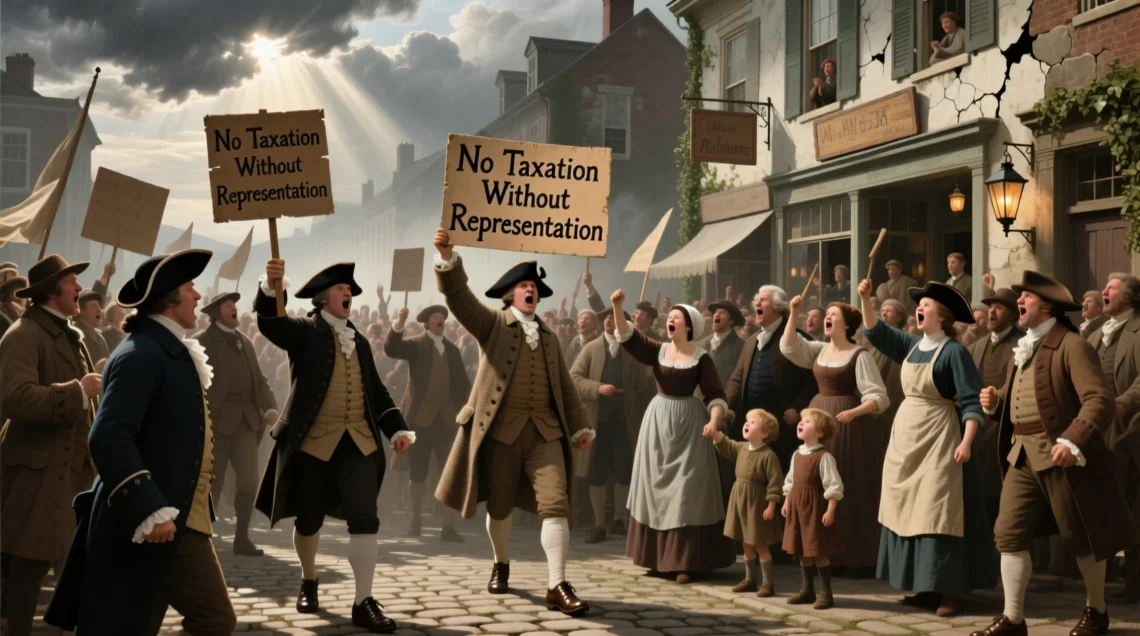
If you’ve ever opened a history book or watched a documentary about the American Revolution, you’ve probably heard the famous phrase “No taxation without representation.” The first time I heard it in school, I thought it was just an old saying from a dusty past.
But the more I understood it, the more powerful and relevant it felt a sentence that changed an entire nation.
People searching what does no taxation without representation mean usually want a simple explanation without complicated historical jargon. And that’s exactly what you’ll get here.
⭐ Quick Answer:
“No taxation without representation” means that people should not be taxed by a government unless they have elected representatives to speak and vote on their behalf.
It’s a political and democratic principle used to demand fairness, rights, and a voice in government decisions.
🧠 What Does “No Taxation Without Representation” Mean?
The phrase “No taxation without representation” became the rallying cry of the American colonists in the 1760s–1770s. It expressed their anger at being forced to pay taxes to the British government without having any elected representatives in the British Parliament.
In simple words:
👉 You shouldn’t have to pay taxes to a government if you don’t get a say in how that government works.
Example:
“Why should we pay British taxes when not a single colonist sits in Parliament?”
In short:
No taxation without representation = No taxes without political voice = Demand for fair government.
📱 Where Is This Phrase Commonly Used?
Even though it comes from the 1700s, this phrase is still very much alive today. You’ll find it used in:
- 🇺🇸 American History classes
- 📚 Political science discussions
- 📰 Articles about government rights
- 🚫 Movements against unfair taxation
- 🗳️ Voting rights campaigns
- 🏛️ Debates on democracy and representation
Tone:
It is formal, political, educational, and often used in serious discussions about rights and fairness.
💬 Examples of “No Taxation Without Representation” in Conversation
Here are some natural, real-life style examples:
1.
A: Why were the colonists so angry at Britain?
B: Because they believed in “no taxation without representation.”
2.
A: What sparked the American Revolution?
B: That whole “no taxation without representation” situation.
3.
A: Why is D.C. asking for voting rights?
B: They’re basically saying “no taxation without representation.”
4.
A: Why is this phrase important in history?
B: It’s about fairness — paying taxes but having no voice.
5.
A: I don’t understand that slogan on the license plate.
B: It’s “no taxation without representation.” It’s D.C.’s way of protesting lack of voting power.
6.
A: So the colonists wanted freedom?
B: Mostly, they wanted representation first.
7.
A: Is the phrase still relevant today?
B: Yes, it’s still used in political debates.
🕓 When to Use and When NOT to Use “No Taxation Without Representation”
✅ When to Use
Use this phrase when:
- Discussing American history
- Talking about fair government
- Debating taxation laws
- Mentioning civil rights issues
- Explaining the American Revolution
- Talking about Washington D.C.’s voting rights
❌ When NOT to Use
Avoid using it when:
- Having casual, everyday conversations
- Talking about modern taxes unrelated to politics
- Making jokes about money (it’s usually too serious)
- Discussing personal finances
- Writing informal messages or slang-based content
📊 Comparison Table
| Context | Example Phrase | Why It Works |
|---|---|---|
| History class | “The colonists argued for ‘no taxation without representation.’” | Accurate & educational |
| Political debate | “Citizens want representation before taxation.” | Formal & relevant |
| Conversation about rights | “It’s unfair—no taxation without representation.” | Expresses fairness |
| Workplace talk | “We should review tax policies.” | Professional alternative |
| “Let’s discuss equitable tax laws.” | Clear & formal |
🔄 Similar Terms or Related Concepts
| Term | Meaning | When to Use |
|---|---|---|
| Representation | Having elected officials speak for you | Political discussions |
| Democracy | Government by the people | Explaining voting rights |
| Civil rights | Basic rights and freedoms | Rights-based conversations |
| Self-governance | People controlling their own government | Historical discussions |
| Tax justice | Fair and balanced taxation | Modern political debates |
| Equality before the law | Everyone has equal rights | Legal and rights topics |
❓ FAQs
1. Who first said “No taxation without representation”?
James Otis, an American lawyer, is often credited with popularizing the idea.
2. Why did the colonists oppose British taxes?
Because they had no representatives in Parliament to vote on their behalf.
3. Is this phrase still relevant today?
Yes — especially in discussions about Washington D.C. voting rights.
4. What taxes caused the conflict?
The Stamp Act, Tea Act, Sugar Act, and other British-imposed taxes.
5. Did this phrase lead to the American Revolution?
Absolutely — it was one of the core reasons behind the revolution.
6. Does it apply to modern tax systems?
Indirectly — people still argue about fairness and representation in taxation.
🧠 Quick Quiz
Test Your Understanding!
- What does “no taxation without representation” mean?
- Which country were the colonists protesting against?
- Name one tax act that caused the conflict.
- Which U.S. district still uses this phrase today?
- Is the phrase casual or formal?
(Answers: 1. No taxes without political voice. 2. Britain. 3. Stamp Act/Tea Act/Sugar Act. 4. Washington D.C. 5. Formal.)
📝 Conclusion
The phrase “No taxation without representation” is more than a historical slogan — it’s a bold declaration of fairness, democracy, and the right to have a voice. It shaped the birth of America and continues to influence political debates today. Whether you’re studying history or trying to understand modern rights discussions, this phrase remains a powerful reminder:
👉 No one should be taxed by a government they can’t participate in.