
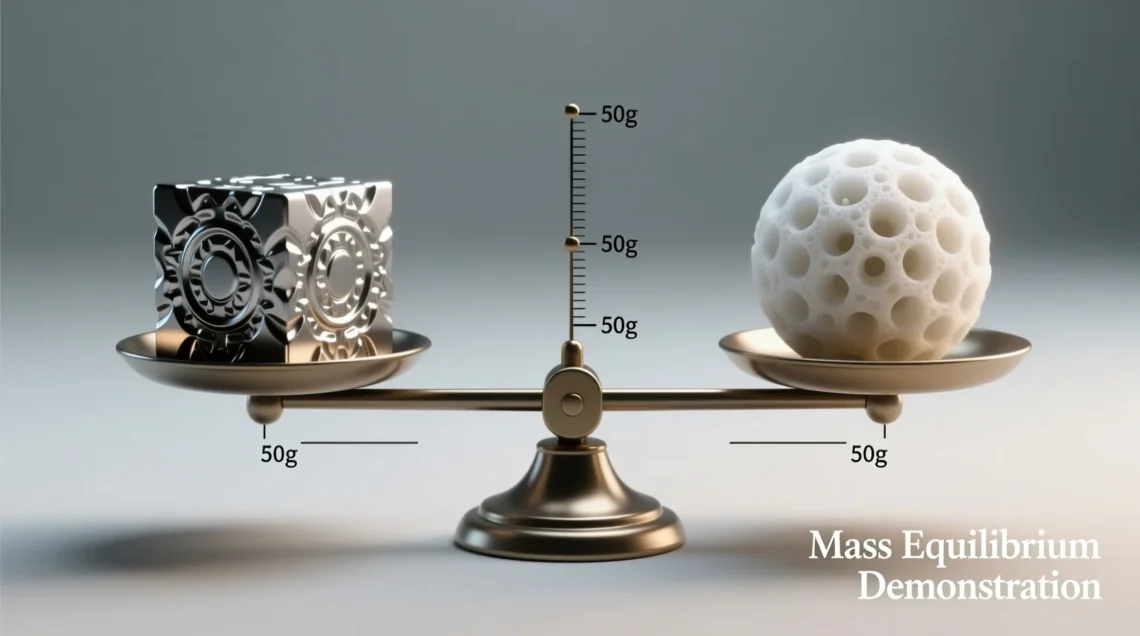
If you’ve ever been in a science class or reading something about physics and saw the word “mass”, you probably paused for a moment. I remember the first time a teacher told us, “Mass is not the same as weight,” and the entire class looked confused. It feels like a simple word, yet it carries a very specific scientific meaning.
So if you’re wondering what mass really means, how it is used, and why it’s different from weight, you’re in the right place.
Quick Answer:
Mass means the amount of matter in an object. It is a scientific and physical measurement that does not change based on location or gravity.
🧠 What Does Mass Mean?
In science, mass refers to the quantity of matter in an object.
It tells us how much substance something contains.
It is measured in:
- kilograms (kg)
- grams (g)
- pounds (lb) (less common scientifically)
✔ Example Sentence:
“The brick has more mass than the sponge, even though they’re the same size.”
In short:
Mass = Amount of matter = Remains constant everywhere.
This is one of the most important concepts in physics, chemistry, astronomy, and engineering.
📱 Where Is the Word “Mass” Commonly Used?
You’ll see the word mass used in:
🔬 Science
- Physics
- Chemistry
- Biology
- Engineering
🌍 Daily Life
- Gym and fitness
- Cooking
- Comparing objects
- Talking about weight (though often confused)
✝ Religious (Different Meaning)
In Christianity, “Mass” refers to a religious ceremony, especially in Catholic tradition.
(This article focuses on the scientific meaning, but the word does have that second usage.)
🧪 Tone:
Educational, scientific, neutral.
💬 Examples of “Mass” in Real Conversations
Here are natural usage examples:
1
A: why is the rock heavier than the sponge?
B: it has more mass, even though they’re similar size.
2
A: does mass change on the moon?
B: no—only weight changes.
3
A: what’s the mass of this dumbbell?
B: it says 5kg.
4
A: I thought weight and mass were the same.
B: nope, mass stays the same everywhere.
5
A: how do scientists measure mass?
B: usually with a balance, not a scale.
6
A: what’s the mass of the Earth?
B: about 5.97 × 10²⁴ kg.
7
A: is mass the same as size?
B: not always—some small objects have large mass.
🕓 When to Use and When NOT to Use “Mass”
✅ Use “Mass” When:
- Talking about scientific measurements
- Comparing amounts of matter
- Explaining weight differences
- Describing physical properties
- Discussing physics or chemistry
❌ Do NOT Use “Mass” When:
- You mean weight (force due to gravity)
- Talking about size or volume
- Referring to religious Mass (different meaning)
- Talking about crowds (e.g., “mass of people” — different usage)
📊 Comparison Table: Mass vs Weight
| Concept | Example | Why It Works |
|---|---|---|
| Mass | “The mass is 2 kg.” | Scientific & accurate |
| Weight | “The weight is 20 N.” | Weight is force, not matter |
| Formal Explanation | “Mass remains constant regardless of location.” | Fits scientific writing |
| Casual | “It’s heavy because it has more mass.” | Easy to understand |
🔄 Similar Terms or Alternatives
| Term | Meaning | When to Use |
|---|---|---|
| Weight | Force of gravity on an object | When describing heaviness |
| Volume | Space an object occupies | When size matters |
| Density | Mass per unit volume | When comparing compactness |
| Matter | Material substance | Broad scientific discussions |
| Force | Push or pull | Physics equations |
| Inertia | Resistance to change in motion | Related to mass |
⚖ Understanding Mass: Key Points Students Often Miss
⭐ 1. Mass Stays the Same Everywhere
Even on the moon, Mars, or a spaceship.
⭐ 2. Weight Depends on Gravity
More gravity = more weight.
Mass stays constant.
⭐ 3. Mass Is Measured in Kilograms
Weight is measured in Newtons (N).
⭐ 4. Sport vs Science
Fitness equipment labeled “10kg” actually refers to mass, not weight.
⭐ 5. Volume ≠ Mass
A big object can have low mass (e.g., a balloon).
🙋 FAQs
1. What does mass really mean?
Mass means the amount of matter in an object.
2. Is mass the same as weight?
No. Weight depends on gravity; mass doesn’t.
3. Does mass change on the moon?
No. Only weight changes.
4. What is the SI unit of mass?
Kilogram (kg).
5. How is mass measured?
Using a balance, not a scale.
6. Is mass the same as size?
Not always — density changes everything.
7. What’s the mass of the Earth?
About 5.97 × 10²⁴ kg.
📝 Mini Quiz — Test Your Understanding!
1. Mass depends on:
a) Gravity
b) Weight
c) Amount of matter ✔
d) Speed
2. Which has more mass?
a) A balloon
b) A stone ✔
3. Does mass change in space?
a) Yes
b) No ✔
4. What unit measures mass?
a) Newton
b) Pascal
c) Kilogram ✔
d) Watt
5. Which sentence is correct?
a) “Weight stays the same everywhere.”
b) “Mass stays the same everywhere.” ✔
📝 Conclusion
Mass is one of the most important concepts in science. It tells us how much matter an object has and remains constant no matter where you are in the universe. Understanding the difference between mass and weight helps you grasp physics, fitness, engineering, and even everyday life more clearly.
Now that you know exactly what mass means, you can use the term confidently and correctly — whether you’re in school, at the gym, or simply curious about how the world works.