
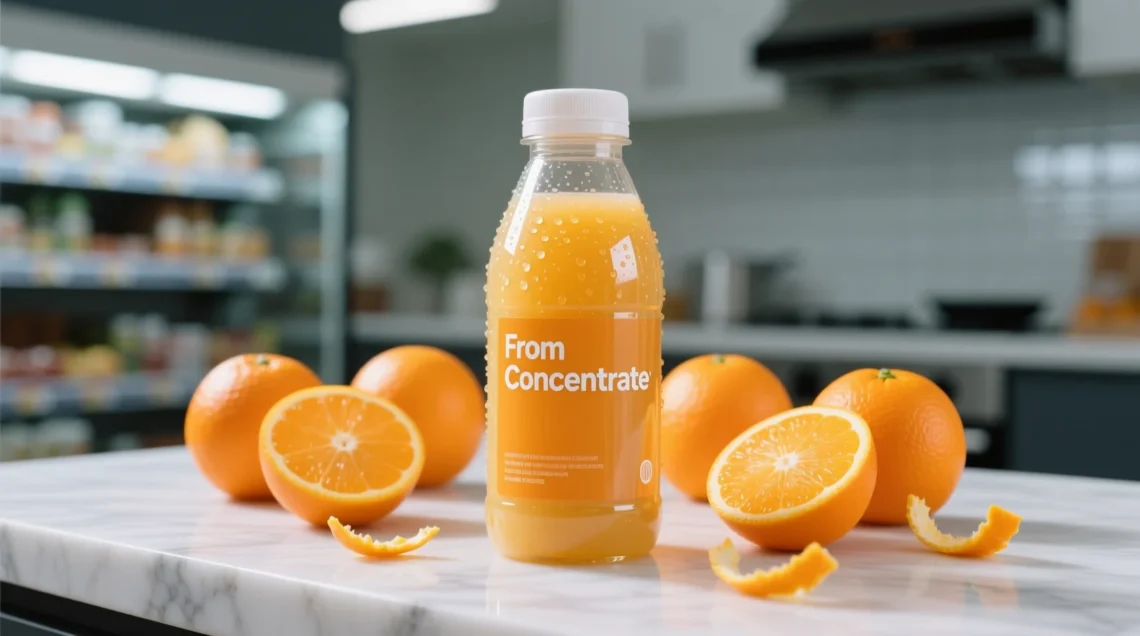
The first time I picked up a juice carton that said “Made From Concentrate,” I honestly thought it meant the juice was somehow stronger or more intense. Later, I learned that it actually refers to how the juice is processed — not how strong it tastes.
If you’ve ever stood in the grocery store wondering what “from concentrate” actually means, whether it’s healthy, and how it compares to not-from-concentrate juice, this guide explains everything clearly, with examples, tables, FAQs, and even a quiz to test your understanding.
🧠 What Does “From Concentrate” Mean?
“From concentrate” means the juice was originally fresh juice, but the water was removed to create a thicker, syrup-like concentrate. Later, water is added back before packaging.
It’s still real juice, just processed for easier shipping and longer shelf life.
✔ Simple Explanation:
Fresh juice → water removed → concentrated → water added back → packaged juice
This reduces size, cost, and waste during transportation.
✔ Example Sentence:
“This orange juice is made from concentrate, so the water was removed and re-added later.”
✔ Summary:
From concentrate = Real juice with water removed → then restored.
🧪 Why Juice Companies Use Concentrate
Removing the water makes shipping 80–90% cheaper because the liquid becomes lightweight and compact. Manufacturers later add:
- Clean drinking water
- Sometimes flavor packs
- Sometimes vitamin C
- Sometimes sweeteners (varies by brand)
It’s not always worse — it depends on the brand and added ingredients.
📱 Where You’ll See “From Concentrate”
You’ll commonly see this term on:
🛒 Grocery Products
- Orange juice cartons
- Apple juice bottles
- Lemon/lime juice
- Frozen juice cans
- Fruit syrups
- Juice blends
🌍 Food & Beverage Industry
- Restaurants
- Cafes
- Smoothie chains
📦 Food Labels
Anywhere you see “Ingredients:” you may find:
- Water, orange juice concentrate
- Apple juice concentrate, added sugar
Tone:
This is informational, neutral, and industry-standard labeling.
🍊 Examples of “From Concentrate” in Real Life
- “This lemonade is made from concentrate. The brand adds water and sugar before bottling.”
- “Most boxed juices in schools come from concentrate because it’s cheaper to produce.”
- “I prefer not-from-concentrate orange juice because the flavor tastes fresher.”
- “Apple juice from concentrate often tastes sweeter due to added flavoring.”
- “You can buy frozen concentrate and mix it with water at home.”
🕓 When to Choose or Avoid “From Concentrate”
✅ Choose ‘From Concentrate’ When:
- You want a cheaper option
- You prefer sweeter or smoother juice
- You don’t mind slight processing
- You’re buying frozen juice concentrate for recipes
- You need juice for cooking (marinades, baking, sauces)
❌ Avoid ‘From Concentrate’ When:
- You want the freshest taste
- You want the least processed juice
- You’re avoiding added sugar
- You want juice that tastes close to freshly squeezed
- The product includes artificial flavors or additives
📊 Comparison Table: From Concentrate vs Not-From-Concentrate
| Feature | From Concentrate | Not-From-Concentrate |
|---|---|---|
| Process | Water removed & restored | Minimal processing |
| Taste | Slightly sweeter or uniform | Fresher & more natural |
| Price | Usually cheaper | More expensive |
| Shelf Life | Longer | Shorter |
| Additives | Sometimes included | Rarely |
| Shipping | Efficient | Less efficient |
| Overall | Budget-friendly & consistent | Higher quality experience |
🔄 Similar Terms (and What They Mean)
| Term | Meaning | When It Applies |
|---|---|---|
| Not From Concentrate (NFC) | Fresh juice, minimal processing | Premium juices |
| Freshly Squeezed | Directly squeezed, no processing | Restaurants + premium brands |
| Reconstituted Juice | Same as “from concentrate” | Food industry term |
| 100% Juice | All juice, no fillers | Can still be from concentrate |
| Juice Drink | Juice + water + sugar | Not the same as pure juice |
| Fruit Beverage | Low juice content | Flavored drink, not real juice |
🧬 Is “From Concentrate” Healthy?
Short answer: Yes, it can be — depending on additives.
✔ Healthy if:
- No added sugar
- No artificial flavors
- Labeled “100% juice”
✔ Less healthy if:
- Contains high fructose corn syrup
- Has artificial color
- Includes preservatives
- Marketed as “juice drink” instead of juice
From-concentrate juice still contains vitamins, especially vitamin C, but may lose some micronutrients during heating.
🍋 Why Some People Prefer Not-From-Concentrate
- fresher taste
- fewer additives
- more natural texture
- closer to freshly squeezed juice
- perceived as healthier
Taste is the biggest factor.
🧁 Cooking Uses for Concentrate
Concentrated juice is excellent in:
- Cakes & cupcakes
- Marinades
- Icing / frosting
- Mocktails
- Cocktails
- Fruit sauces
- Glazes
It adds intense flavor without extra liquid.
🙋 FAQs
1. Is juice from concentrate real juice?
Yes — it starts as real fruit juice.
2. Is from concentrate bad?
No, unless it contains added sugars or artificial ingredients.
3. Is not-from-concentrate healthier?
Slightly — it undergoes less processing.
4. Why does concentrated juice taste sweeter?
Because heating during concentration enhances natural sugars.
5. Does from-concentrate juice lose nutrients?
Yes, but mostly small amounts of heat-sensitive vitamins.
6. Is frozen concentrate the same as liquid concentrate?
Yes — just frozen for storage.
7. Does “100% juice” mean no concentrate?
No, 100% juice can still be made from concentrate.
📝 Mini Quiz — Test Your Understanding!
1. What does “from concentrate” mean?
a) Artificial juice
b) Juice with water removed, then added back ✔
c) Freshly squeezed juice
2. Does concentrate start as real fruit juice?
a) Yes ✔
b) No
3. Which one is usually more expensive?
a) From concentrate
b) Not-from-concentrate ✔
4. Which product may include additives?
a) From concentrate ✔
b) Freshly squeezed
5. Is “reconstituted juice” the same as from concentrate?
a) Yes ✔
b) No
📝 Conclusion
The term “from concentrate” simply describes the processing method used to produce juice more efficiently. The water is removed, the liquid becomes concentrated, then water is added back before packaging. It’s still real juice and can be healthy especially when labeled 100% juice with no added sugar.
Whether you choose from-concentrate or not-from-concentrate comes down to your preference for taste, cost, and level of processing.