I still remember the first time I came across the word “concurrent” in a work email. The sentence read: “These tasks will run concurrently.” I stared at it for a moment, wondering whether it was a technical term, a scheduling issue, or something related to law.
If you’ve ever felt confused by the word concurrent, you’re not alone. It’s a formal-sounding word that shows up in business, law, technology, academics, and even medicine — but it always carries the same core meaning.
This guide explains the meaning of concurrent in simple words, with examples, usage, tables, comparisons, FAQs, and a mini quiz.
🧠 What Does “Concurrent” Mean?
✔ Happening at the same time
or
✔ Existing together or operating simultaneously
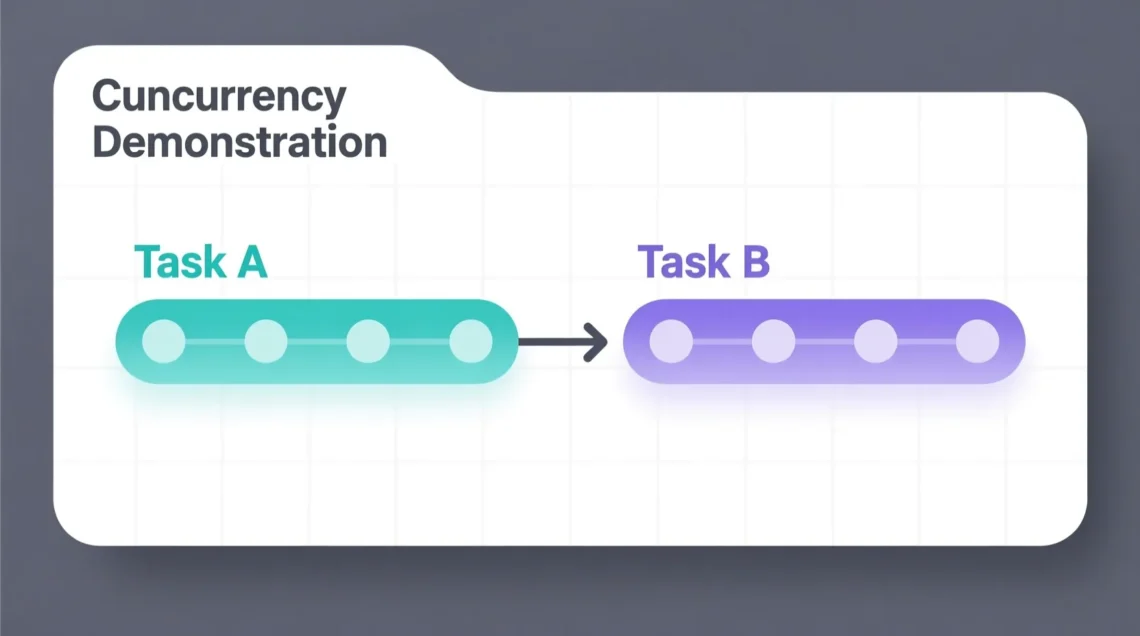
It refers to events, actions, tasks, or conditions that overlap in time.
✔ Example Sentence:
“The two meetings were scheduled concurrently, so I had to pick one.”
In short:
Concurrent = simultaneous = happening together.
🔍 Where Is the Word “Concurrent” Commonly Used?
The term appears in many fields. Here are the most common areas:
📌 1. Business & Work
- Concurrent tasks
- Concurrent projects
- Concurrent deadlines
📌 2. Technology & Software
- Concurrent programming
- Multiple processes running at the same time
📌 3. Legal System
- Concurrent sentences (served at the same time)
- Concurrent jurisdiction (shared authority)
📌 4. Medical Field
- Concurrent symptoms
- Concurrent medications
📌 5. Everyday Language
- Concurrent events
- Concurrent responsibilities
- Concurrent school schedules
✅ Tone:
Formal, professional, and academic.
💬 Examples of “Concurrent” in Real Sentences
✔ Work & Business
- “We’re running three projects concurrently this quarter.”
- “Concurrent tasks help us reduce production time.”
✔ Technology
- “The app supports concurrent users.”
- “The system can handle concurrent data operations.”
✔ Law
- “The judge ordered concurrent sentences for both charges.”
- “They have concurrent jurisdiction in this matter.”
✔ Medical
- “The patient has two concurrent infections.”
- “Concurrent treatment methods may be required.”
✔ Everyday Use
- “Two parties were happening concurrently at the hotel.”
- “She manages her job and studies concurrently.”
🧩 Different Types of Concurrent Use
| Type | Meaning | Example |
|---|---|---|
| Concurrent Events | Happen at the same time | A wedding & birthday party |
| Concurrent Tasks | Performed together | Multitasking at work |
| Concurrent Sentences (Law) | Served simultaneously | 2-year + 3-year term = 3 years total |
| Concurrent Programming | Multiple processes running | Apps running in the background |
| Concurrent Symptoms | Multiple symptoms at once | Fever + cough |
🔄 Concurrent vs. Similar Words: What’s the Difference?
| Word | Meaning | Difference |
|---|---|---|
| Concurrent | happening at the same time | General & widely used |
| Simultaneous | exactly at the same moment | More precise |
| Parallel | side-by-side processes | Can be simultaneous OR independent |
| Coexisting | existing together | Not always time-related |
| Coinciding | happening at the same time | More event-based |
🕓 When to Use and When NOT to Use “Concurrent”
✅ Use “Concurrent” When:
- Two or more things overlap in time
- You’re describing schedules or timelines
- You’re explaining processes in work or tech
- Writing professionally or academically
- Talking about legal sentences or responsibilities
❌ Do NOT Use “Concurrent” When:
- Things happen one after another
- You’re describing random coincidences
- You mean “parallel” but not “simultaneous”
- You’re writing informally (use “at the same time” instead)
📊 Usage Table: Correct Contexts for “Concurrent”
| Context | Example Phrase | Why It Works |
|---|---|---|
| Professional Email | “We will run both campaigns concurrently.” | Clear & formal |
| Legal Document | “The sentences will be served concurrently.” | Standard legal term |
| Tech Documentation | “The server handles 200 concurrent requests.” | Accurate technical use |
| Work Chat | “Two tasks are running at the same time.” | More casual wording |
| Academic Writing | “Concurrent research was conducted.” | Scholarly tone |
🔄 Similar Terms or Alternatives
| Term | Meaning | When to Use |
|---|---|---|
| Simultaneous | Exactly same moment | Precision required |
| Parallel | Side-by-side processes | Tasks not dependent |
| Coexisting | Happening together | Describing conditions |
| Coincident | Occurring together | Events aligning |
| Synchronous | Coordinated timing | Technical use |
| At the same time | Informal version | Casual speech |
🙋 FAQs
1. Does concurrent always mean at the exact same time?
Not always. It generally means overlapping in time, not necessarily identical timing.
2. Is concurrent a formal word?
Yes. It’s more common in professional or academic writing.
3. What does concurrent mean in programming?
Multiple tasks running during the same timeframe (not necessarily simultaneously).
4. What does concurrent mean in law?
Sentences served at the same time, not one after the other.
5. Is concurrent the same as simultaneous?
Similar, but “simultaneous” is more precise.
6. Can people have concurrent jobs?
Yes — two or more jobs they work during overlapping hours.
7. What is the opposite of concurrent?
Sequential (one after another).
📝 Mini Quiz — Test Your Understanding
1. What does concurrent mean?
a) One after another
b) Happening at the same time ✔
c) Starting late
2. Which sentence uses “concurrent” correctly?
a) “He finished the jobs concurrently.”
b) “The workshops will run concurrently.” ✔
c) “Concurrent means opposite.”
3. What is a legal example of concurrent use?
a) Concurrent sentences ✔
b) Concurrent sandwiches
c) Concurrent parking
4. Opposite of concurrent is:
a) Parallel
b) Sequential ✔
c) Conditional
5. Which is a synonym of concurrent?
a) Simultaneous ✔
b) Random
c) Alternate
📝 Conclusion
The word concurrent simply means happening at the same time, and it’s widely used in business, technology, law, medicine, and everyday life. Whether describing tasks, events, processes, or sentences, it adds clarity and a formal tone to writing.
Now you fully understand what concurrent means, how to use it correctly, what its synonyms are, and when not to use it.