Hey there, messaging champ 👋! Ever been in a chat where someone just replies with “IDM”, and you pause wondering what “IDM” means? It’s totally normal. Whether you’re texting friends, dropping comments on Instagram, playing in a gaming group or even chatting in a work group—these shorthand acronyms sneak in everywhere.
If you’re someone who uses apps like WhatsApp, Snapchat, Discord or just scrolls social media often, this guide is for you. We’ll unpack exactly what “IDM” means in text, why people use it, how you can use it (or respond to it), and when you might want to skip it.
Understanding these little abbreviations helps you stay ahead, avoid misunderstandings, and keep your digital convo game strong. Let’s dive in!
Definition & Meaning
IDM stands for “I Don’t Mind.”
It’s used when someone wants to express that they’re okay with a suggestion or have no strong preference.
“IDM” means ‘I Don’t Mind’ — a casual abbreviation used in texting to show you’re okay with any option or you have no strong preference.
Examples:
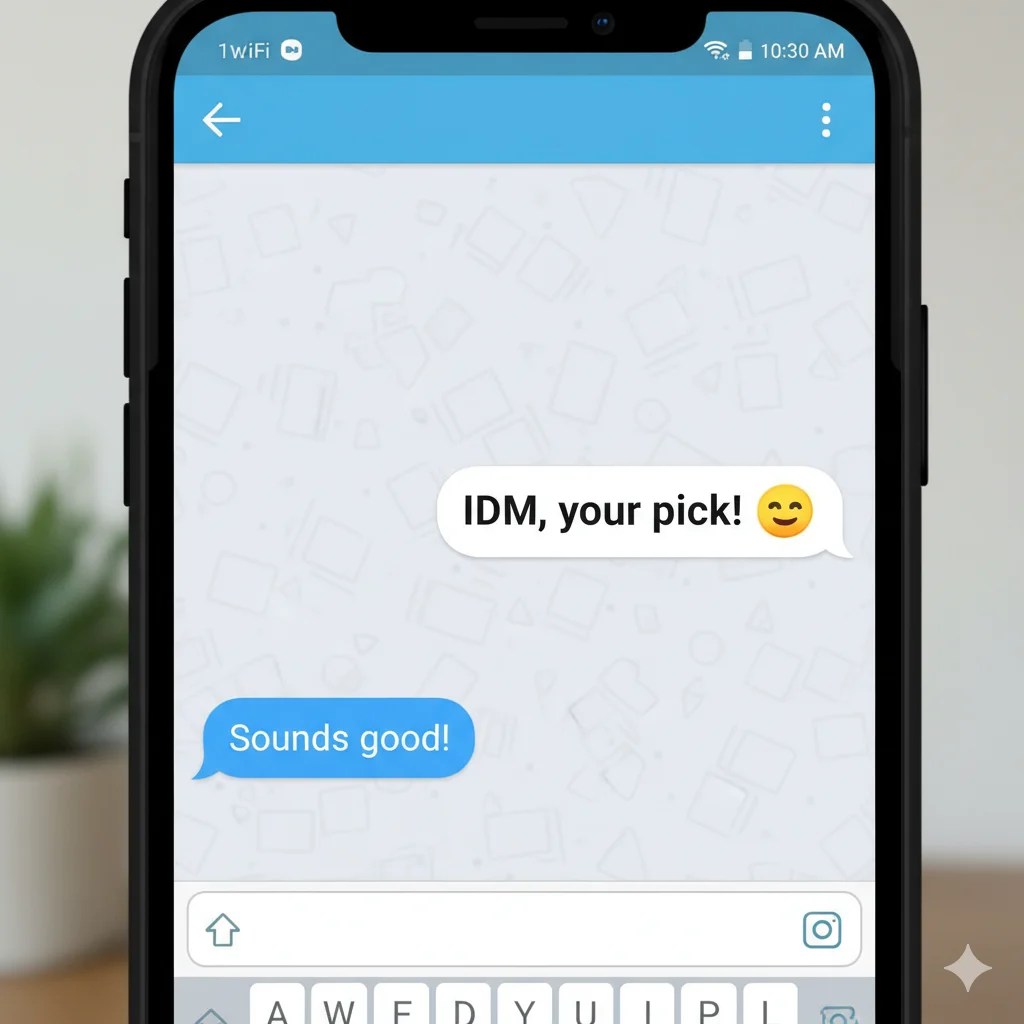
Friend 1: “Pizza or burgers tonight?”
Friend 2: “IDM, your pick!”
→ Here “IDM” = “I don’t mind (either option).”
Example 2:
Teammate: “Should we start at 7 pm or 8 pm?”
You: “IDM, whatever works for the group.”
→ Flexibility.
Important note: In some other non-texting contexts, “IDM” might mean “Intelligent Dance Music” (a genre) or “Internet Download Manager” (a software) — but in everyday texting chats, it almost always means “I don’t mind.”
So remember: when you see “IDM” in a casual chat, chances are someone is being easy-going, not listing a software program.
Background & History
The abbreviation “IDM” emerged from the digital age of texting and online chatrooms, where brevity matters. As people wanted to reply quickly and keep conversation flowing, longer phrases got shortened.
In the early days of mobile texting and instant messaging apps, acronyms like “IDK” (I don’t know), “IDC” (I don’t care) became very common; “IDM” (I don’t mind) followed naturally as a polite, neutral alternative.
Although the term also has roots in other fields — for example, as “Intelligent Dance Music” (a genre of electronic music) dating back to the 1990s.
Today “IDM” is used across texting apps, social media comments, group chats, and even workplace informal chats—whenever someone wants to convey that they’re flexible or don’t have a strong preference.
Usage in Various Contexts
Texting & Messaging
Example:
Sara: “Meeting at 5 or 6?”
James: “IDM, either time is fine.”
Here “IDM” shows that James has no strong preference and leaves the choice.
Social Media / Comments
“IDM which filter I use for my story — both look good.”
A quick way to show you’re easy-going about the options.
Gaming / Group Chats
Teammate: “Map A or Map B?”
You: “IDM, choose Map A if you want.”
Such usage helps speed up decision-making when many players are involved.
Professional / Work-Safe Contexts
In work chats you might see:
Colleague: “Should we review on Monday or Tuesday?”
You: “IDM — either is fine.”
While it’s okay in casual internal chat, note that it’s still quite informal for official emails or serious professional communication.
Common Misconceptions & Clarifications
- ❌ Misconception: “IDM” means “I don’t care.”
Clarification: Actually “IDM” means “I don’t mind” — which implies flexibility or neutrality rather than outright indifference. - ❌ Misconception: “IDM” can always be used formally.
Clarification: No — it’s informal slang. Even though it’s polite, it may seem too casual in formal writing or professional emails. - ✅ Important: Pay attention to tone and context. If someone types “IDM.” with a dot and no emoji, it might feel a bit detached. If they type “IDM 😊” it feels more friendly. Context and punctuation matter.
Similar Terms & Alternatives
| Term | Meaning | Tone |
|---|---|---|
| IDC | I Don’t Care | More dismissive |
| IDR | I Don’t Remember | Memory-gap admission |
| IMO | In My Opinion | Giving your view |
| IDM | I Don’t Mind | Flexible, neutral |
| TBH | To Be Honest | Reflective, opinion-based |
When you want to express neutrality or flexibility, IDM works best. If you want to show you don’t care at all (which may sound negative), IDC might fit—but use carefully.
How to Respond to “IDM”
Casual Response
Friend: “We can go for coffee or tea?”
You: “IDM — coffee sounds good.”
Funny Response
Friend: “We should pick a movie.”
You: “IDM, but if you pick horror I’m blaming you! 😂”
Professional/Polite Response
Colleague: “Should we aim for next week?”
You: “Sure — I don’t mind either way. Monday or Tuesday works.”
Privacy-Conscious Response
If you really don’t want to reveal flexibility but want to sound polite:
“I’m fine either way — you pick and I’ll go with it.”
This avoids using slang and keeps it professional.
Regional or Cultural Differences
“IDM” is most common in English-speaking countries such as the U.S., U.K., Canada, Australia.
In other regions, equivalent phrases might be spelled out instead of using the acronym (e.g., “I don’t mind” in full).
In non-native English texting communities, sometimes “IDM” might be misunderstood or not used at all—so when you chat internationally, be aware the abbreviation might not be familiar.
Also, younger generations might use it more freely on platforms like TikTok and Snapchat, while older generations might stick to full phrases.
Comparison with Similar Terms
| Abbreviation | Full Form | Typical Meaning | Formality |
|---|---|---|---|
| IDM | I Don’t Mind | I’m okay with either option | Informal |
| IDC | I Don’t Care | I’m not bothered / indifferent | Informal/Negative |
| IDR | I Don’t Remember | I can’t remember | Informal |
| IMO | In My Opinion | My view on something | Casual |
| TBH | To Be Honest | Giving a candid thought | Casual |
This table helps you pick the right abbreviation depending on your tone and situation.
Usage in Online Communities & Dating Apps
On dating apps like Tinder, Bumble, or chat platforms like Discord, “IDM” can appear when someone doesn’t have a strong preference:
“IDM which movie we watch — you choose 🙂”
This shows you’re easygoing in a casual conversation.
In online communities or group chats:
“We doing a raid tonight or tomorrow?”
“IDM, I’ll be around either way.”
It helps groups decide quickly.
Tip: On dating apps, using “IDM” can signal you’re flexible and low-stress—which can be a plus.
Hidden or Offensive Meanings
There are no widely recognized offensive meanings of “IDM” in texting. It’s generally safe and friendly.
However, misuse or tone can affect perception:
- If you write “IDM.” in a serious conversation without explanation, it might feel dismissive or cold.
- Over-use might make you appear indecisive or uninterested. If someone asks a serious question and you answer “IDM,” they might expect more engagement.
So, use it appropriately—knowing when a full reply is better.
Suitability for Professional Communication
In professional settings, “IDM” is usually too informal.
Better alternatives:
- “I’m open to either option.”
- “I don’t have a strong preference.”
- “Whatever works best for the team.”
If you use “IDM,” your message might appear too casual, especially in external emails, formal reports or high-stakes discussions.
FAQs
1. What does IDM mean in text?
→ It stands for “I Don’t Mind,” showing that you’re okay with any option.
2. Is IDM the same as IDC?
No — IDC means “I Don’t Care,” which can sound dismissive. IDM is more polite and flexible.
3. Can IDM be used in professional emails?
Not recommended — it’s informal. Use full phrases instead.
4. Where is IDM most commonly used?
In casual texting, online chats, social media DMs, group chats.
5. Does IDM have other meanings?
Yes — in music, “IDM” can mean “Intelligent Dance Music,” and in tech, “Internet Download Manager.” But in casual texting it means “I Don’t Mind.”
Conclusion
To wrap it up — when you see “IDM” in a message, you can confidently read it as “I Don’t Mind.” It’s a quick, informal way to show you’re flexible or open to any plan.
Use it in casual chats, group texting, or when you’re okay with letting someone else choose. Just remember: keep it consistent with the tone of the conversation. If you’re in a formal setting, stick to full phrasing.
Next time you reply “IDM,” you’ll do so with style and clarity. 😉